By the end of this course, you will (1) describe physiological and biomechanical changes during menopause and (2) implement movement, Pilates, and lifestyle strategies to improve health and quality of life. Under the guidance of physiotherapist Phillipa Butler, you’ll learn how hormonal changes affect bone, muscle, and connective tissue, and how exercise can mitigate symptoms and long-term risks.

Movement Strategies for Menopause Health

Movement Strategies for Menopause Health
This course is part of Empowering Women's Wellness: Holistic Movement and Mobility Specialization

Instructor: Niel Asher Education
Included with
Gain insight into a topic and learn the fundamentals.
Intermediate level
Recommended experience
5 hours to complete
Flexible schedule
Learn at your own pace
What you'll learn
How to design exercise programs addressing menopause-related changes
How to support symptom relief and long-term wellness through movement
Skills you'll gain
Details to know

Shareable certificate
Add to your LinkedIn profile
Recently updated!
December 2025
Assessments
7 assignments
Taught in English
See how employees at top companies are mastering in-demand skills

Build your subject-matter expertise
This course is part of the Empowering Women's Wellness: Holistic Movement and Mobility Specialization
When you enroll in this course, you'll also be enrolled in this Specialization.
- Learn new concepts from industry experts
- Gain a foundational understanding of a subject or tool
- Develop job-relevant skills with hands-on projects
- Earn a shareable career certificate

There are 8 modules in this course
Explore how targeted movement, Pilates principles, and manual therapy can support women through the physical and emotional transitions of menopause. Guided by Phillipa Butler, PT MSCP, this course integrates exercise science, biomechanics, and women’s health education to help therapists understand the systemic effects of hormonal changes on the body. You’ll learn how to identify menopausal symptoms, address musculoskeletal imbalances, and apply stabilization and breathing techniques that promote joint alignment, strength, and core control. This course empowers therapists to use movement as medicine—reducing pain, improving posture, and enhancing overall quality of life for women experiencing menopause. Suitable for massage therapists, physical therapists, Pilates practitioners, and healthcare professionals.
What's included
2 videos2 readings1 assignment1 discussion prompt
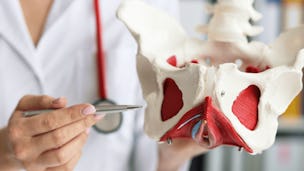
This module outlines common pelvic floor–related symptoms experienced during menopause such as urgency, leakage, pelvic pressure, and discomfort. Students learn how hormonal changes influence tissue elasticity, muscle coordination, and continence, and how movement and education can help reduce symptoms and improve confidence in daily life.
What's included
1 video1 assignment
Students are introduced to six foundational principles that guide movement and rehabilitation for menopausal clients, including breath coordination, alignment, core control, and progressive loading. These principles create a safe and effective framework for restoring stability and addressing functional changes.
What's included
1 video1 assignment
This module demonstrates assessment strategies for identifying pelvic floor dysfunction, including alignment observation, breathing mechanics, and functional movement screening. The focus is on recognizing the relationship between posture, core strategy, and pelvic symptoms.
What's included
1 video1 assignment
Through guided demonstrations, this module applies the concepts from earlier lessons to address bone loading, balance, resistance training, and functional stability. Students learn how to design movement programs that enhance strength, mobility, and confidence through menopause and beyond.
What's included
4 videos1 assignment
This final module reviews the key concepts covered throughout the course and reinforces how they integrate into clinical practice. Learners will reflect on gained knowledge, confirm their understanding of core principles, and prepare for the final exam required for course completion.
What's included
1 video
This module provides an opportunity to apply key concepts from the course through self-directed activities and reflective practice. Learners will deepen their understanding by analyzing case examples, reinforcing assessment skills, and integrating appropriate movement and treatment strategies into practical scenarios.
What's included
1 reading1 assignment1 discussion prompt
This final exam is designed to assess your understanding of the key concepts presented throughout the course. Please review all video lessons and written materials before beginning. A passing score of 70% or higher is required to successfully complete the course and earn your CE certificate. You may reference your notes during the exam. Once you pass, your certificate will be available for immediate download.
What's included
1 assignment
Earn a career certificate
Add this credential to your LinkedIn profile, resume, or CV. Share it on social media and in your performance review.
Instructor
Offered by


Explore more from Patient Care
Niel Asher Education

Niel Asher Education
Why people choose Coursera for their career

Felipe M.
Learner since 2018
"To be able to take courses at my own pace and rhythm has been an amazing experience. I can learn whenever it fits my schedule and mood."

Jennifer J.
Learner since 2020
"I directly applied the concepts and skills I learned from my courses to an exciting new project at work."

Larry W.
Learner since 2021
"When I need courses on topics that my university doesn't offer, Coursera is one of the best places to go."

Chaitanya A.
"Learning isn't just about being better at your job: it's so much more than that. Coursera allows me to learn without limits."

Open new doors with Coursera Plus
Unlimited access to 10,000+ world-class courses, hands-on projects, and job-ready certificate programs - all included in your subscription
Advance your career with an online degree
Earn a degree from world-class universities - 100% online
Join over 3,400 global companies that choose Coursera for Business
Upskill your employees to excel in the digital economy
Frequently asked questions
To access the course materials, assignments and to earn a Certificate, you will need to purchase the Certificate experience when you enroll in a course. You can try a Free Trial instead, or apply for Financial Aid. The course may offer 'Full Course, No Certificate' instead. This option lets you see all course materials, submit required assessments, and get a final grade. This also means that you will not be able to purchase a Certificate experience.
When you enroll in the course, you get access to all of the courses in the Specialization, and you earn a certificate when you complete the work. Your electronic Certificate will be added to your Accomplishments page - from there, you can print your Certificate or add it to your LinkedIn profile.
Yes. In select learning programs, you can apply for financial aid or a scholarship if you can’t afford the enrollment fee. If fin aid or scholarship is available for your learning program selection, you’ll find a link to apply on the description page.
More questions
Financial aid available,