Business Marketing: How to Build an Effective Strategy
Learn how business models shape business marketing by determining the right audience, messaging, and channels. And follow a step-by-step guide to build an effective approach to marketing your business.
![[Featured image] Four colleagues sit at a conference table discussing business marketing.](https://d3njjcbhbojbot.cloudfront.net/api/utilities/v1/imageproxy/https://images.ctfassets.net/wp1lcwdav1p1/6mxaJ3dP3klP3kWDkbEgl6/76b0e47d3427fd4b76eadad8f2f27b50/GettyImages-912920596.jpg?w=1500&h=680&q=60&fit=fill&f=faces&fm=jpg&fl=progressive&auto=format%2Ccompress&dpr=1&w=1000)
Key takeaways
Business marketing involves communicating the value of your company's product or service, as well as brand, across different marketing channels.
Effective business marketing first requires an understanding of your business model—B2B, B2C, or B2G—because this will inform the strategy you develop to reach the right audience.
Business marketing strategies typically begin with the four Ps: product, price, place, and promotion.
Business marketing often takes place through traditional channels, such as print ads, or digital channels like social media and email marketing.
Discover what it takes to successfully market a business. Afterward, consider enrolling in the Google Digital Marketing and E-commerce Professional Certificate. You’ll have the opportunity to build e-commerce stores, analyze online performance, and grow customer loyalty.
How do business models shape business marketing?
Every successful marketing campaign starts with a fundamental question: who are you trying to reach? For business marketing, the answer is rooted in the company's business model. The three more common models include:
Business-to-business: B2B companies sell products or services directly to other businesses (sometimes called enterprise).
Business-to-consumer: B2C businesses sell directly to individual consumers.
Business-to-government: B2G companies provide products or services to government agencies at local, state, or federal levels.
Developing an effective business marketing strategy means first understanding your business model, because that information will determine several crucial factors, including your audience, what kind of messaging will most resonate with them, and what channels you'll use to share that messaging. Let's look at the difference in business marketing focus across audience, messaging, and channel selection.
Audience identification
Your business model fundamentally determines who you're trying to reach:
B2B marketers: target job titles, industries, and company sizes
B2C marketers: focus on demographics, psychographics, and lifestyle factors
B2G marketers": identify specific agencies, departments, and procurement officers
Messaging
Each model requires distinct communication approaches:
B2B messaging: emphasizes ROI, efficiency, and business outcomes
B2C messaging: appeals to emotions, personal benefits, and lifestyle enhancement
B2G messaging: highlights compliance, cost-effectiveness, and public benefit
Channel selection
Understanding your model helps determine where to invest marketing resources for maximum impact, ensuring your message reaches the right audience through their preferred traditional or digital channels.
How to market your business
When marketing a business, your goal should be to communicate your value: as a brand as well as the products or services you offer. Both of these kinds of messaging will help you remain competitive over time. Let's review steps you'll need to follow to market a business.
Small business example: Terracotta
Across the steps that follow, we'll use a fictional company called Terracotta, a small ceramics business based in Los Angeles, to provide more concrete examples. Let's dive in.

1. Begin with the 4 Ps.
A marketing strategy is a long-term vision that defines the value of your product or service. To understand what your value is, begin by outlining the four Ps, which is a marketing mix that looks at four essential components: product, price, place, and promotion.
Answer the following questions:
Product: What do you sell?
Price: What do you charge?
Place: Where do you sell it?
Promotion: What, if any, messaging have you done to convey its value?
Terracotta’s 4 Ps
As the owner of Terracotta, you offer a product because you sell handmade pottery bowls in the Greater Los Angeles area. You recently launched, so your customers have been friends, word-of-mouth consumers, and people who found your shop when passing by. You’ve created a brand logo and website, and you've acquired social media handles, but have done no actual promotion.
2. Conduct an industry analysis.
A market analysis is an opportunity to define your target audience as well as the larger competitive landscape your product will be situated in, among other pieces of information. Both of these primary factors will lead you to develop more specific marketing efforts.
Target market: Your target market will be the groups of potential customers (business, consumers, or government agencies) that your goods will most resonate with. You may want to conduct surveys or interviews or use marketing analytics tools to "listen" and understand their unique needs. Once you have this information, it's a good idea to segment these groups by demographics (age, gender, marital status, education, and income) and psychographics (lifestyle, hobbies, and interests).
Terracotta’s target audience
Females between 25 and 55 years old who enjoy spending time bonding over an activity, such as making pottery or shopping. Salary ranging from $50,000 to $95,000. Lives in Los Angeles or is a tourist. Attended college or university.
Buyer persona 1: Fran is 27 years old and enjoys supporting ethical, sustainable brands. She loves plants and enjoys decorating her studio apartment. Fran has bought several Terracotta bowls and is considering taking up pottery as a hobby.
Buyer persona 2: Callie is a 43-year-old mother of three. She lives in Manhattan Beach with her family and works from home. She does yoga and pilates three times a week. When shopping downtown, she enjoys picking up a few specialty items for herself or friends.
Competitors: After defining who you’re selling to, it's important to do a competitor analysis to differentiate your product or service from other businesses that exist in the market. You can find competitors by conducting an online search to see what companies sell similar products in your area. Make a list of your five main competitors and spend time looking at their branding and messaging. How do they convey their value? Now, look at your product or service. What are your strengths and weaknesses compared to these other businesses? What makes your product unique? How does your pricing strategy compare?
Terracotta’s competitors
With Terracotta, your main competitors in Los Angeles are numerous craft brands that sell handmade ceramic bowls. The differentiating factor is that your bowls and vases have a natural brown-orange color and are sold unglazed. The brand’s ethos relies on these earthy imperfections, so the price point is slightly lower than that of other craft brands.
3. Build a business marketing strategy.
Now that you've completed the crucial research portion of marketing, it’s time to develop your strategy. The marketing strategy you develop will depend on your marketing budget, your audience, and even the size of your marketing team.
Identify the channels that will be most effective in reaching your audience. make the most sense to focus on. There are many types of marketing to choose from, such as traditional (print, advertising), digital (social media, content, email, and SEO), event, influencer, and guerrilla. You will likely work with a few different types of marketing rather than choose one and pursue it exclusively.
Business marketing strategies in action
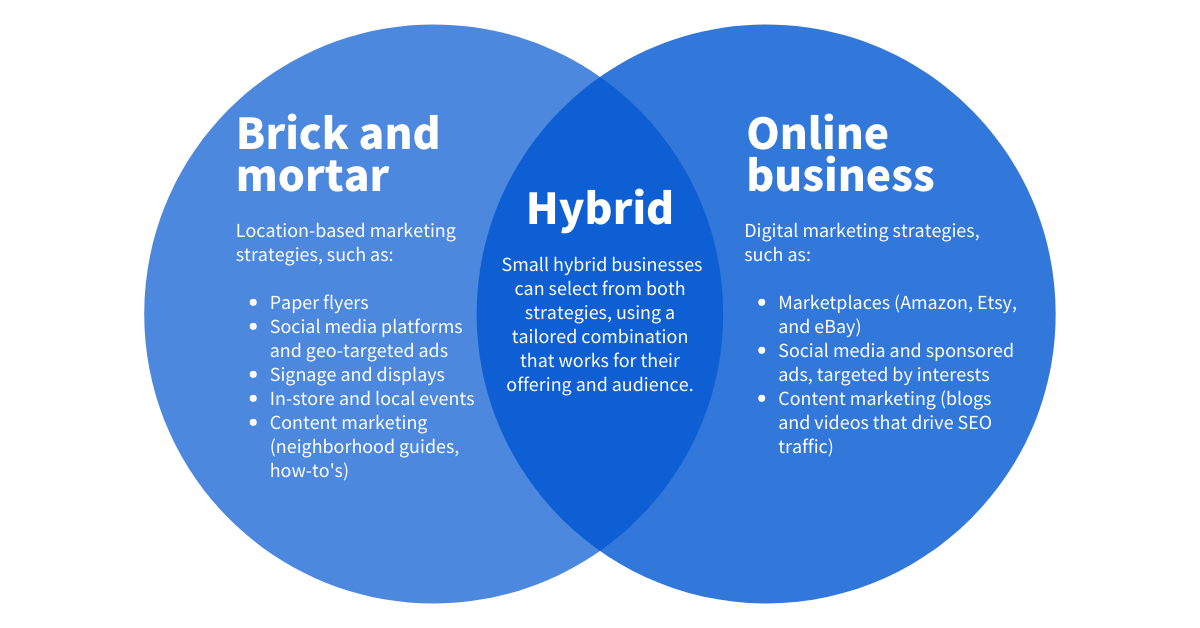
Let’s take a closer look at what strategies might work for brick-and-mortar, online, and hybrid businesses:
Brick and mortar: Strategies should be location-based for businesses that sell products and services in a physical shop. You might choose from a combination of the following:
Paper flyers at local businesses, and signage and displays
Social media platforms for promotions, updates, and ads
In-store and local events
Online: Online businesses can take advantage of the many types of digital marketing available today to drive traffic and convert it into sales.
Marketplaces such as Amazon, Etsy, and eBay, in addition to your website
Social media and sponsored ads (targeted by interest)
Content marketing (blogs and videos to drive SEO traffic)
Hybrid: Small businesses can select from both strategies, using a tailored combination that works for their offering and audience.
Terracotta’s strategy
As a brick-and-mortar business, you create a strategy for Terracotta that involves a combination of in-person and online marketing:
• Official launch event
• Weekly Instagram posts and daily stories featuring new products
• Paid Instagram advertising (sponsored ads)
• Booth at local craft shows, farmer’s markets, and festivals
• Etsy shop
• Media features from select publications
4. Create a marketing plan.
A marketing plan is how you will go about enacting the marketing strategy you've created, such as hiring a social media manager, working with local SEO specialists to develop blog content, and developing the timeline for your marketing campaigns.
It helps to figure out which channels you'd like to focus on. Understanding those factors will determine the plan you eventually put in place.
Terracotta’s marketing plan
For Terracotta, you created a Google marketing calendar with different colors for each part of the plan. You hired a full-time intern to help with event planning and digital marketing, and help out in the store.
You are in charge of measuring impact and tracking sales. After three months, you compare the percentage of monthly sales to refine the strategy and plan.
5. Analyze your efforts.
Marketing doesn't end once your messaging is out in the world. It's important to monitor how potential and current customers receive and respond to that messaging, as well as your return on investment (ROI). ROI explains how the efforts you've made have paid off.
If your marketing efforts increase sales, that can be a good indication that you've successfully conveyed your value. However, if you find that's not the case, you will likely need to adjust your marketing strategy and marketing plan. It's important to use analytical marketing technology (MarTech) to track and monitor how things are going.
Keep up with the business marketing industry
Looking to learn more about marketing tactics? Subscribe to our Career Chat newsletter on LinkedIn for the latest marketing trends and tips. Then, explore free, digital resources for professional growth:
Watch on YouTube: 5 AI Tools That Will TRANSFORM Your Digital Marketing Strategy
Explore careers: Digital Marketing Career Paths: Explore Roles & Specializations
Gain insights: Guerrilla Marketing: Methods, Madness, and Monkey Business
Accelerate your career growth with a Coursera Plus subscription. When you enroll in either the monthly or annual option, you’ll get access to over 10,000 courses.



Coursera Staff
Editorial Team
Coursera’s editorial team is comprised of highly experienced professional editors, writers, and fact...
This content has been made available for informational purposes only. Learners are advised to conduct additional research to ensure that courses and other credentials pursued meet their personal, professional, and financial goals.